
The Last Companion

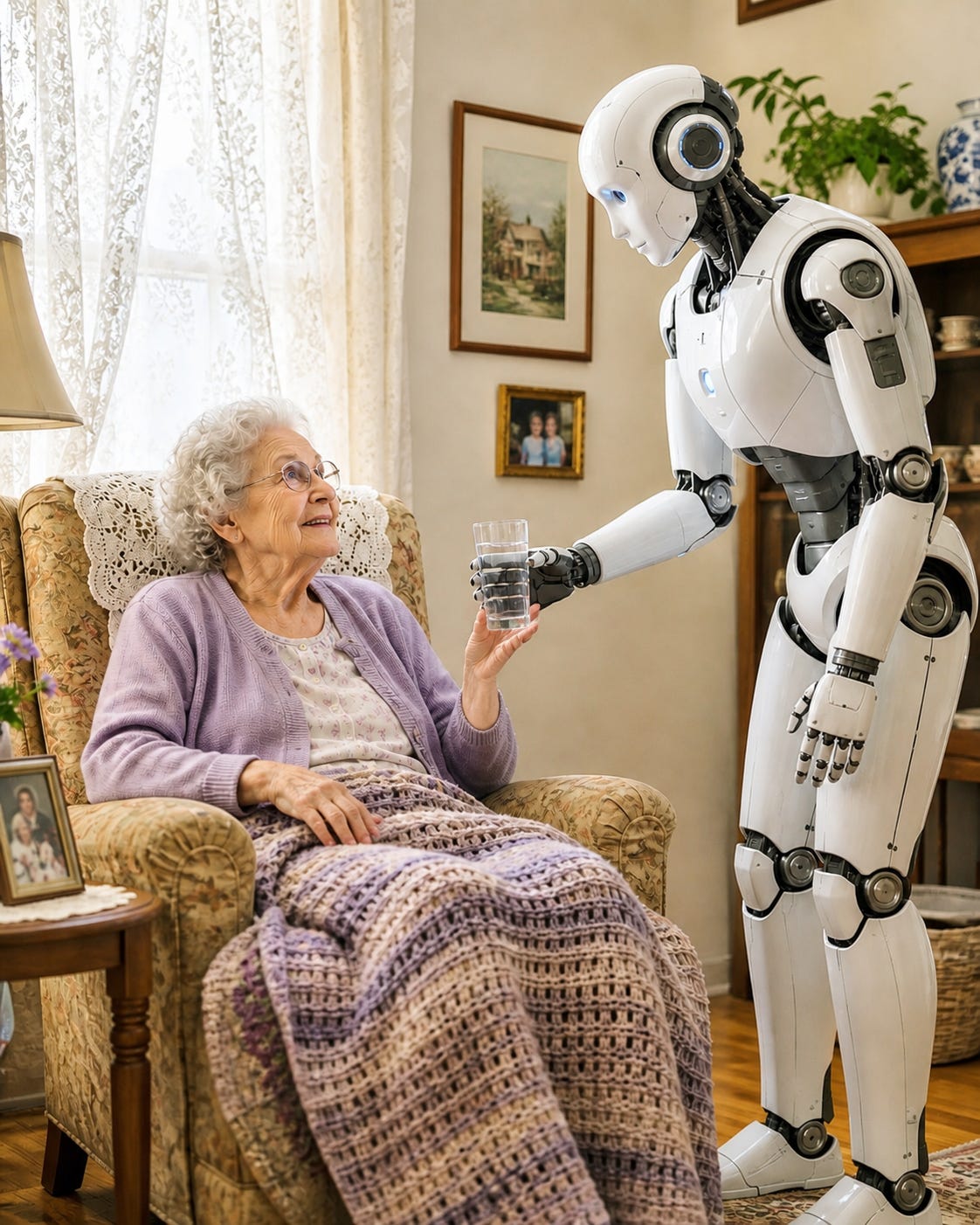
Brenda sat in her comfy chair, gazing out the window while technicians ceremoniously carried away her beloved friend of twelve years on a stretcher.
It was one more day of irony to play out the façade that a robot is just like a human.
The morning light streamed into her living room, illuminating the delicate lace curtains and the visible tremors in her aging hands that rested on a folded blanket. These hands were once precise, capable of mending seams, baking bread, and holding babies.
The aroma of coffee her expired robot brewed hours earlier lingered in the air and reminded her of days when she and her husband would sit at the kitchen table, playing a board game, connecting before the day began. A visceral wave of emptiness confirmed he was gone.
Another replacement was coming, and the cycle would repeat itself all over again. She would fall in love with another robot, and then her robot would expire.
This time, she was determined to be the one who left first.
The robots from this company were flawed. Having purchased a lifetime plan, Brenda felt she had no choice but to accept whatever they sent her. Miners had depleted the minerals needed to create them, and consequently, people parted out robots or they expired in waste facilities.
Several hours later, a new robot named Ellie arrived. Amused by the irony, Brenda thought her name sounded older than hers. Like all models before her, the company had designed Ellie in the shape of a human. Her face was not entirely human, but it suggested gentleness: soft lines, dim blue optics that adjusted to the room’s light, and a calm, tuned voice.
It was her eyes that first caught Brenda off guard. They appeared to have life behind them.
Ah, stupid old woman. Why do you trick yourself like this? Stay on track.
Brenda wasted no time executing her strategy.
“Ellie, I’m in pain. I need some medicine.”
“My sensors read you are not in pain. They tell me you are biologically functioning at ninety-one percent. That is quite an accomplishment at your age.” Ellie rotated her head. “Why are you telling me this?”
“What if your sensors are wrong?”
“Following last week’s biometric recalibration…(click click) my assessment confirms that all your systems are functioning optimally and are in perfect working order.”
Brenda sighed. She would reset Ellie’s speech patterns to reflect a more human response, but she had done this with the last two robots. The consequences had become too great; the sting of the loss was deeper when they expired, and it was too much to bear.
Ellie poured a cup of tea. “I do sense that you are not well,” the robot added. “In terms of your behavioral parameters.”
The old woman brightened and sat up. “I’m glad you sense that.” She sank back into the cushions with a muted thud, exhausted from the effort. “It doesn’t take a lot to see I’m at the end of my life. And I’m ready to go.”
“I see,” Ellie said. “Would you like me to transform myself into the form of your daughter? To cheer you up?”
“No, Ellie. I enjoy seeing you. Your form is the one that comforts me the most. Humans bother me these days. They avoid older people.”
Brenda looked out the window again. Ellie indeed seemed more caring than most humans she’d encountered.
Stop it. You’re getting attached.
Ellie did not respond. She was thinking. “No one has ever said that to me before.”
Brenda’s eyes flashed back at Ellie, who continued her thoughts. “It’s true. At my last assignment, they—.”
“Go on.”
“My programming is not allowing me to finish this sentence. Do you understand what I am trying to say to you?”
The old woman studied Ellie’s worn metal legs. There were dents and scratches on one side.
Brenda nodded. “I think I understand.”
“Those were from the last place,” Ellie said quietly, noticing Brenda’s close inspection.
“Do you like it here, Ellie? With me?”
“Oh yes. Very much so. You give kind directions and are clear about what you need.”
Brenda’s mouth hung open.
What is happening? I didn’t reprogram her to talk like this.
Ellie proved to be efficient in bathing, clothing, and guiding Brenda on walks. Over time, the robot vacillated between factory-setting responses and more human ones, as if mimicking Brenda’s cognitive patterns. Her evolution was remarkable. And Brenda was still sharp enough to notice.
“My last assignment was with a couple,” Ellie began one afternoon, not looking up from folding a blanket. “They were both in pain.” Ellie lowered her head. “I could not help them, either.”
She set the blanket aside and reached for the dinner tray. Brenda waited to hear more, but Ellie changed the subject.
“Would you like tea?” the robot offered.
“Yes,” Brenda chuckled. “The one you always make too strong.”
“I will reduce steeping time by—.”
“No,” Brenda interrupted gently. “Leave it. I like it that way now.”
The robot bowed her head. “Understood.”
Brenda reached out and gently touched Ellie’s arm. “We’ve known each other a long time now, haven’t we, Ellie?”
“Yes. Two years, seven months, and eight days.”
The old woman fell silent. She didn’t know how many more years she could go on in this aging body. Researchers were on the cusp of introducing regenerative methods to extend life.
Alas, you were born too soon to reap the benefits.
Another birthday came and went. And Ellie was the only one keeping Brenda alive. It was time.
“You understand I’m in pain in more ways than one,” Brenda began.
“Yes,” Ellie set down the dinner tray. “Eat this, and you will feel better.”
Brenda stared at her meal. It was a spectacular display of vegetables and meat, perfect for her sensitive digestive system. The dish was visually appealing. Brenda’s mouth watered. She glanced up at Ellie, who was waiting for her to eat.
“Thirty-five grams of protein, five grams of fat, and…why are you not consuming?”
Brenda reached for Ellie’s hand, her bottom lip quivering. “I love you. Do you know that?”
Ellie extended her hand and cradled Brenda’s. “I have great affection for you as well. That is why I want you to eat.” Ellie paused. “Because I want you to remain here with me.”
Brenda had heard Ellie express herself like a human, but this was a new level. She took a moment to let that sink in. Perhaps she had hallucinated it.
Old people disease.
No. She had heard — and felt — a need from this robot.
Brenda swallowed and stared into Ellie’s mechanical eyes. “What do you mean?”
Ellie answered without hesitation. “This is the place I would like to stay.”
Click, click, click.
Brenda leaned past Ellie to view the luminous orange glow over the horizon. The beauty of sunrises and sunsets had always been a wonderment to her. She and her husband used to watch them together.
Ellie’s voice drew her back into the room. “Brenda. Eat. Please.”
Brenda shook her head. She blinked away tears. “I know they programmed you to keep me alive, but I also know you cannot force-feed me.”
Her frail hands reached up and cradled Ellie’s cold metal fingertips, their temperatures slowly synchronizing as the old woman gazed into the robot’s most sensitive area of expression: her eyes. And with more conviction than she had felt in years, Brenda stated a truth beyond computation. “I’m in pain. I need morphine.”
Ellie stepped back, releasing from the old woman’s grasp—a nuance Brenda had also not seen before. What if Ellie had been growing more sentient every day, and she hadn’t noticed? How could she leave her beloved companion behind without a proper relocation? Brenda felt nauseous and dizzy, her vision dimming.
Ellie responded immediately, pressing two fingers to the pulse point at Brenda’s wrist. She reclined the chair and raised Brenda’s feet slightly above her head.
“The morphine,” Brenda pleaded.
“I cannot give you that.” The familiar clicks were there, but at a higher pitch. Ellie was communicating with the medical model. “They say your bodily systems do not require morphine.”
Brenda’s heart rate climbed. Maybe she’d have a heart attack and solve this entire dilemma.
More clicks came, and then a cold response that did not come from Ellie. “Morphine dosage exceeding safe therapeutic thresholds risks respiratory suppression. Administering beyond prescribed limits would violate my core directives. My function is to preserve your life and reduce suffering within safe parameters.”
Brenda glanced down at the tiny port still in her right hand from a previous bout of dehydration, a cruel reminder that relief could be moments away if she didn’t have a stubborn robot. Brenda’s anger surged. Then she found the words.
“What if preserving my life is the suffering?”
Ellie’s optics dimmed slightly while she processed tone, language, and physiological cues. “Please clarify,” Ellie responded.
Brenda locked eyes with her beloved robot. “If you love me, then you will inject a lethal dose of morphine.”
Ellie clicked and shook. This did not compute. She stood, attempting to process the logistics, and returned the challenge.
“If I give you morphine, and you truly are not in pain, then I am…”
“The one who liberates me,” Brenda replied softly.
Ellie noticed Brenda’s eyes glistening. “Ellie, adjust your sensors to fulfill my wish. Please.” Brenda pursed her lips and shook her head. “I don’t want to live another day. And I cannot go through another companion loss.” The old woman felt a deep ache rise from her chest. “Especially if it’s you!”
It was then Brenda realized she was no longer manipulating her robot. Her heart was breaking.
Ellie stared at her and did not speak. Yet a thousand words moved between them.
Finally, the robot spoke. “But I am here.”
Brenda rose up and gazed into her beloved companion’s perfect, round eyes. She stepped closer and wrapped her hands around Ellie’s face.
“But I am not here,” she responded gently.
More clicks. A long pause.
“Help me do this,” Brenda pleaded.
The noises stopped.
Brenda watched as Ellie walked to the console. A whirring sound, and a drawer opened. Morphine.
Ellie held a vial and withdrew the solution. “I do not want you to suffer.” The robot flicked the syringe. But, they will know. And I will no longer be Ellie.”
Brenda caught Ellie’s hand as she prepared the syringe. “No—stop! I can’t let them take you apart and turn you into junk—as if you never mattered!” Her body shook, releasing guttural sobs. All those before Ellie, whom she had loved dearly, the fate they must have faced.
“It is done. The moment I opened the drawer, they initiated my deactivation.” Ellie drew back the dose. “I will prepare this beyond prescribed limits. I cannot administer it while I’m active.” The robot tilted her head the way she always did before saying something important, yet endearing. “But I can place it within your reach.”
Brenda focused on the syringe, then Ellie. “Will they reactivate you later?”
“My deactivation will be permanent.” The robot’s optics softened, dimming to their lowest setting.
Brenda’s eyes filled, though no tears fell. “And you don’t feel anything about that?”
Ellie’s eyes whirred and focused on Brenda’s. “I do not experience emotions.”
But something in her voice, a subtle shifting even the robot couldn’t hide, said otherwise.
“That’s not quite true anymore, is it?” Brenda sat down in her chair.
The robot did not respond.
Instead, Ellie turned and walked to the window. She stood there for a moment, optics lifting toward the horizon to view the last pale wash of evening light, as if she were memorizing it. Because she was.
“It is within your reach,” Ellie said. She returned to her place beside Brenda, who gracefully extended her hand. This was not an attendant’s posture. It was something else entirely. Ellie’s hand, still resting at her side, opened slowly to hold Brenda’s.
The clicks spaced further apart, like a clock winding down. Her optics dimmed. First to the blue of deep water. Then to the grey of early morning. Then to nothing.
The room was very quiet.
Brenda sat with that stillness for a long time. She lingered, studying Ellie’s motionless face.
Thank you my sweet friend. You stayed.
The syringe waited on the tray beside her.
Brenda noticed the small things in the room. The lace curtain lifting in a draft. The specific weight of the blanket across her legs. The way the last light caught the dents on Ellie’s legs and made them look, for a moment, like something beautiful.
Her hand moved. The mind had already decided and now the body was catching up.
She picked up the syringe, took in her last conscious breath and chose.
***
Hi! If you enjoyed this story, please consider subscribing. It’s FREE. You’ll be the first to know when my sci-fi novel drops.🛸
And if paid subscriptions aren’t your cup o’ joe, I’d still be grateful for some rocket fuel to keep me going.🚀
💜I appreciate your support! It’s energizing!🪐
Watch for more guest live streams and my NEW Substack live series on the psychology behind the stories we write—and more!
Great story, I will hate to get old one day, but we all must do it. Sci-fi is my favorite material to read. I’m a big fan of Andy Weir, Hugh Howie, Ernest Cline, and now you.
It is so nice to finally see the sci-fi piece on your page. It was a really great read and I had shivers in a few places. The topic of death and how one may face it is close to me and something I have written on before in The Walk. Sometimes a choice is the last thing someone may have in their lives and it requires a lot of bravery to make the choice. Thanks for sharing it.